Dressing For Something Bad
cw: death
How do you style someone for a funeral? I share about a lot of the weddings, red carpets, and other celebratory events I get to style people for — about how I work with people to use clothing to express the things they want to celebrate about themselves. But something I’ve never talked about is how many people I’ve styled for things that are, well....bad. Funerals, court appearances, custody battles, breakups. Life events that are so overwhelming that the very idea of figuring out what to wear ON TOP OF IT ALL feels impossible without some support. So they call me. And every time, it brings up the most powerful and complicated stakes of getting dressed.
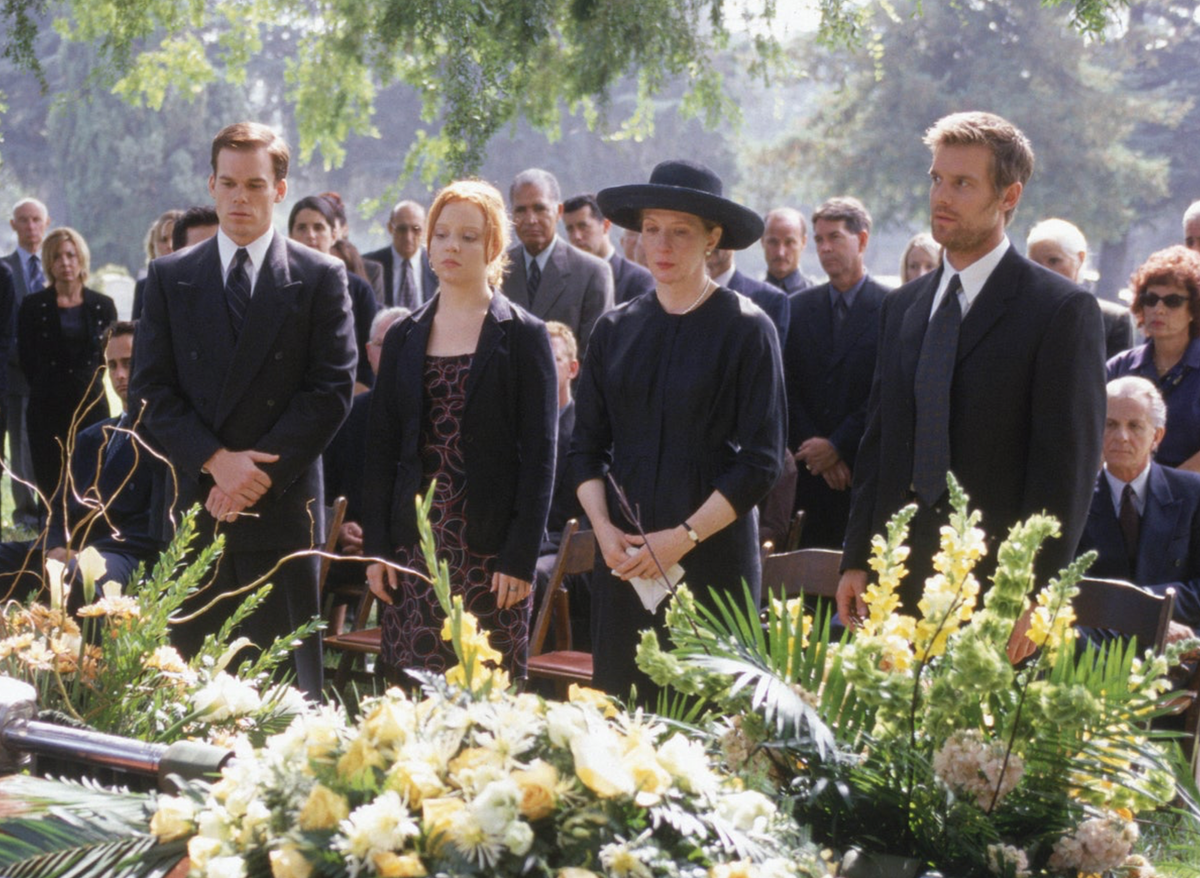
Dressing for a funeral does, in many cases, come with a bit of a playbook. Many cultures have pre-established norms of dress for mourning. Most Western nations (or Catholic, Christian, and Jewish regions) as well as Japan, Brazil, and Thailand (among others) tend to wear black or dark colors. Many Buddhist and Hindu cultures opt for white. And reds and purples can be common in other areas as well. But in an era of bifurcated and overlapping cultures, of reduced religiosity for many, and for more personalized ways of memorializing one’s life -- this rule book can go out the window.
For these more culturally ambiguous memorial events, what does one wear? It’s helpful if the dearly departed has had the opportunity to share their wishes in advance -- “I want this to be a celebration of life! Please wear something bright and fun and dance all night!” But what about if the person did not have a chance to share their wishes? What if it’s not clear? In June we had a memorial for my 5th grade teacher, dear friend, and mentor Kelly Nick (she was the absolute best) who passed away after almost a decade with ovarian cancer. And while she had left us lots of instructions for what she wanted at her memorial (tons of people, dancing, a slideshow, Bruce Springsteen covers), she didn’t say anything about what to wear.
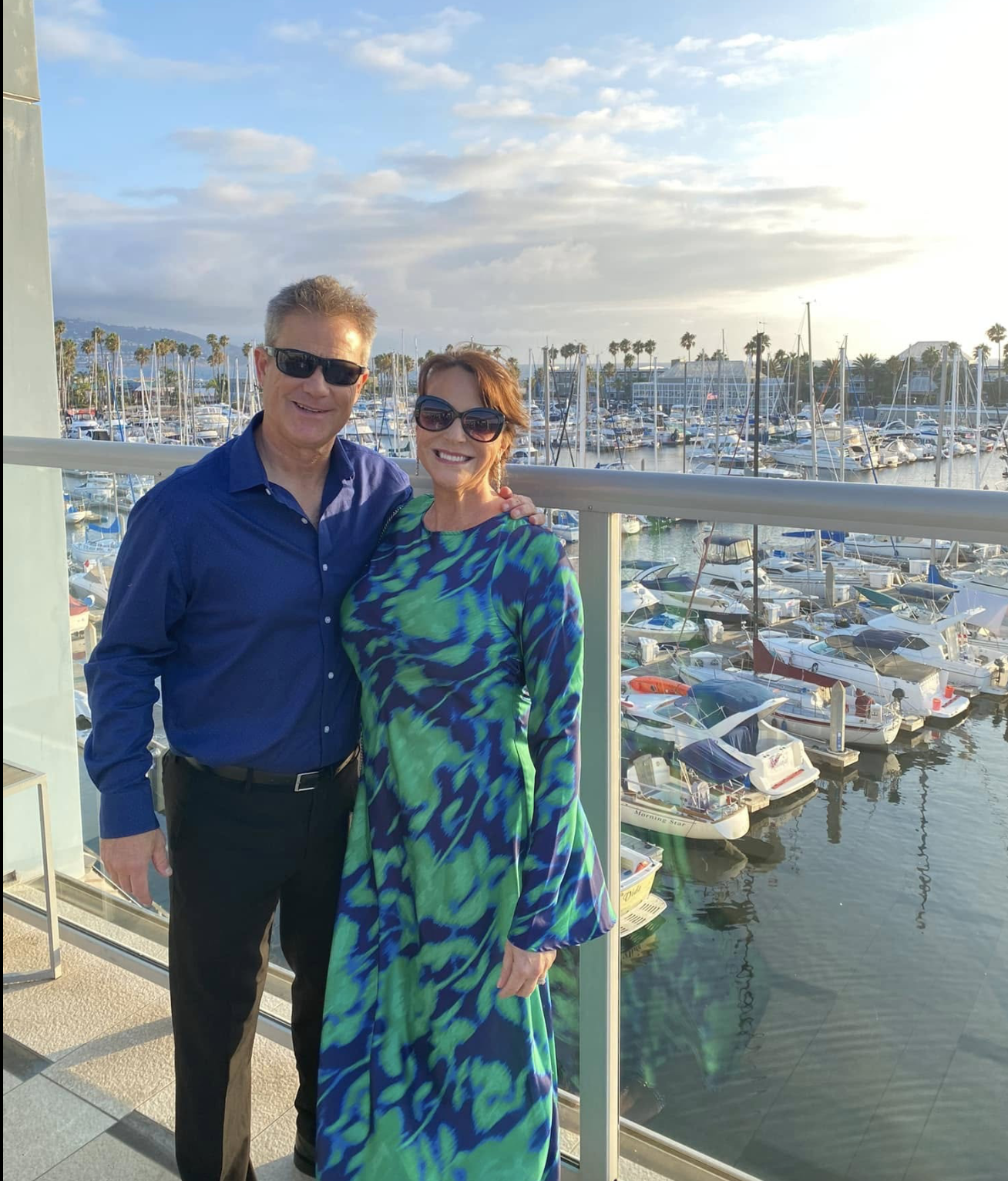
(above: my most beautiful radiant Kelly <3 with her husband Jack)
But when I closed my eyes and imagined her, she was always wearing blue. Even now scrolling through her Facebook (access to photos of her may keep me tethered to Meta forever), it was hard to choose which picture of her wearing blue to include here. So, always her little mini me, I wore blue as well. And as attendees started arriving for the memorial I looked out into a room full of a whole lot of blue. I don’t even know if this was a conscious choice people made or just an innate instinct. People reaching for what made them feel her there.
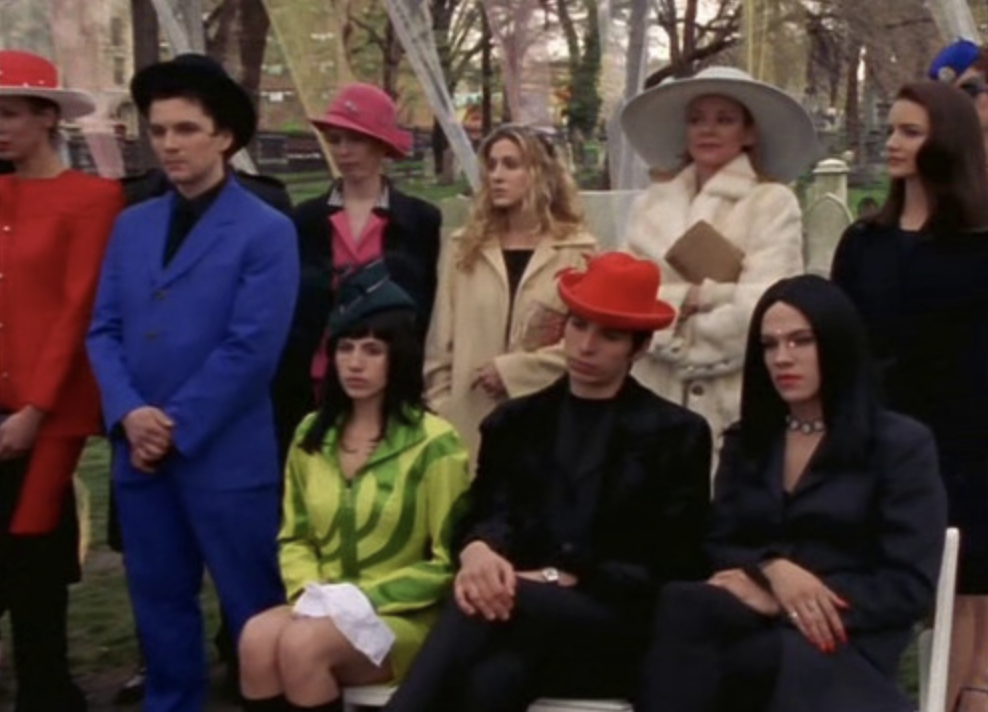
(above: Sex and The City: Four Women and a Funeral where a fashion designer dies suddenly and everyone has to figure out what’s appropriate to wear...traditional mourning colors or one of the late designer’s wild and flamboyant designs)
In my experience working with people through this moment, the closer you were to the deceased, the harder this question becomes. Often, as a person in the depths of grief, the very idea of selecting an outfit feels so impossibly fraught and silly and yet also somehow profoundly important and loaded. If it’s your parent, sibling, partner, or close friend who died, you are often not just dealing with your grief but also the logistics of arranging their funeral, their affairs, their remains. There’s a closeness to it all that can feel like standing with your nose right up against a painting and trying to see it. It brings up so many questions. Do I wear what I already have? Is that appropriate or does that make it seem like I don’t care enough to buy something special for this? Should I wear something I love that makes me feel good or would it feel weird to feel good? Would wearing something I love ruin that piece for me in the future, because I’d always associate it with this? What if my body has changed through caretaking and grief and I have to think about people judging that at this event on top of everything else? What if I look too shlubby, like I didn’t try? What if I look too nice and people think I’m making this about me? The “what ifs” are endless...
Deep grief is perhaps the most extreme example of this, but I’ve also worked with clients who were struggling to figure out what to wear for a court date after a long and traumatizing trial. Or what to wear in a heartbreaking custody battle. Self presentation in these circumstances can be so fraught and dehumanizing -- for women in particular. Lawyers will often advise on attire to make someone appear in a way they think might be more favorable for the case without much sensitivity to how that makes the person feel as a human being. Not too sexy, not too severe, not too youthful, not too matronly, not too flashy — lest they think you asked for it, lest they think you’re irresponsible, lest they think you’re cold, lest they think you’re broke, lest they think you have more money to get at. Trying to dress for something that forces you to dwell in an unhappy part of your life and makes you consider how you are perceived instead of how you feel. It’s dizzying and dehumanizing.
If there’s one thing I’ve found myself repeating to clients in this position, something that has surprised me as I’ve said it but also made total sense, it’s been this:
You may not like what you wear for this, and that might have to be okay. It might even be good.
Because here’s the thing: if there’s anything I’ve learned as a stylist, it’s that people (whether they realize it or not) almost always want to solve problems with their clothes that clothes can’t solve. This isn’t just for the bad stuff. It applies to everything from weddings and red carpets and every day work style to court appearances and funerals. The best outfit on the red carpet cannot solve for the fact that you were undervalued by your colleagues while filming. A perfect dress on your wedding day does not heal a lifetime of cruel body comments from your mother. And certainly, no funeral outfit will bring a loved one back.
And in some ways, taking the pressure off yourself and acknowledging that your outfit will not fix it all is a relief. Admitting that your outfit -- despite being one of the few things in your control in an out-of-control experience -- will not make or break the experience. You have permission to let go a little bit, to not get it exactly right, to just be.
In the best of circumstances, my goal is to help clients reflect what feels good to them in their outfit. That’s at the core of how I approach this work. But if nothing feels good in that moment, you cannot dress well enough to overcome that. If you are not okay, your clothes cannot make you okay. Obviously as a stylist supporting people through these tough circumstances, my hope is to be able to narrow the choices and remove some of the decision fatigue so they can focus on other things, but I always emphasize that the bar for these moments is not so high. You cannot have a great outfit for something you don’t want to have to be doing. The goal is simply to have an outfit that, perhaps at best, gets out of the way of the experience you’re having so that you can simply be there for it as best you can. So that you can sob or fight or dance or zone out without thinking about your outfit at all. And that just might be enough.