Style Beyond Capitalism
What if capitalism doesn't breed innovation, it stunts it?
So if you've heard me rant at all about nearly anything, I've probably mentioned a podcast I'm obsessed with called Articles of Interest (which I was introduced to by a fellow style membership member Mads, so thanks Mads!) which is hosted by journalist Avery Trufelman. Each episode is a deep dive on some small detail of fashion that takes unexpected twists and turns through history, culture, manufacturing, and more. If you're not already listening, definitely check it out! (Then we can discuss episodes in #WatchParty on Discord!)
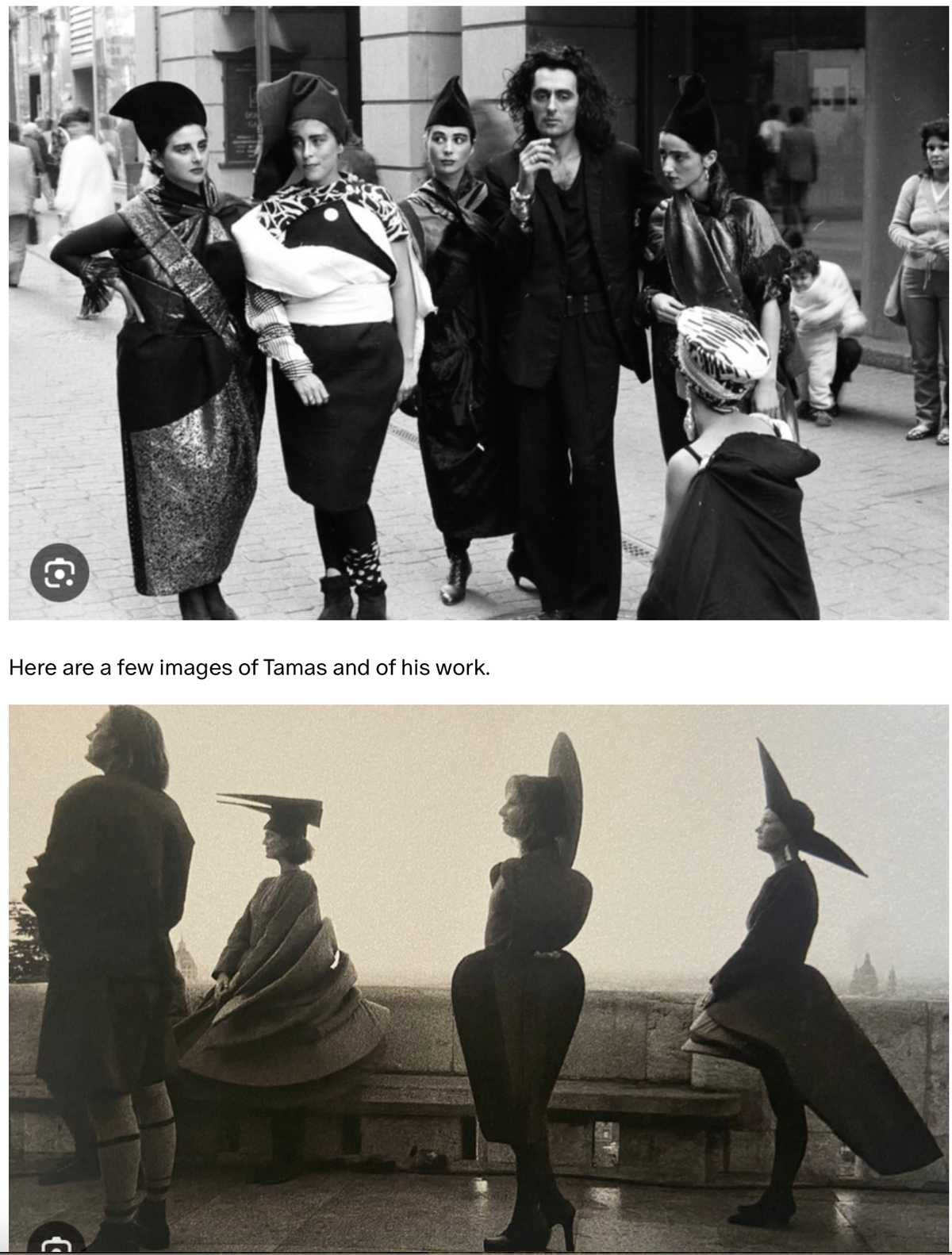
There’s an episode I love called Fashion Without Capitalism, and it centers entirely on Tamas Kiraly, an avant garde Hungarian designer whose most famous work was done in the 1980s, beyond the Iron Curtain and under Communist rule.
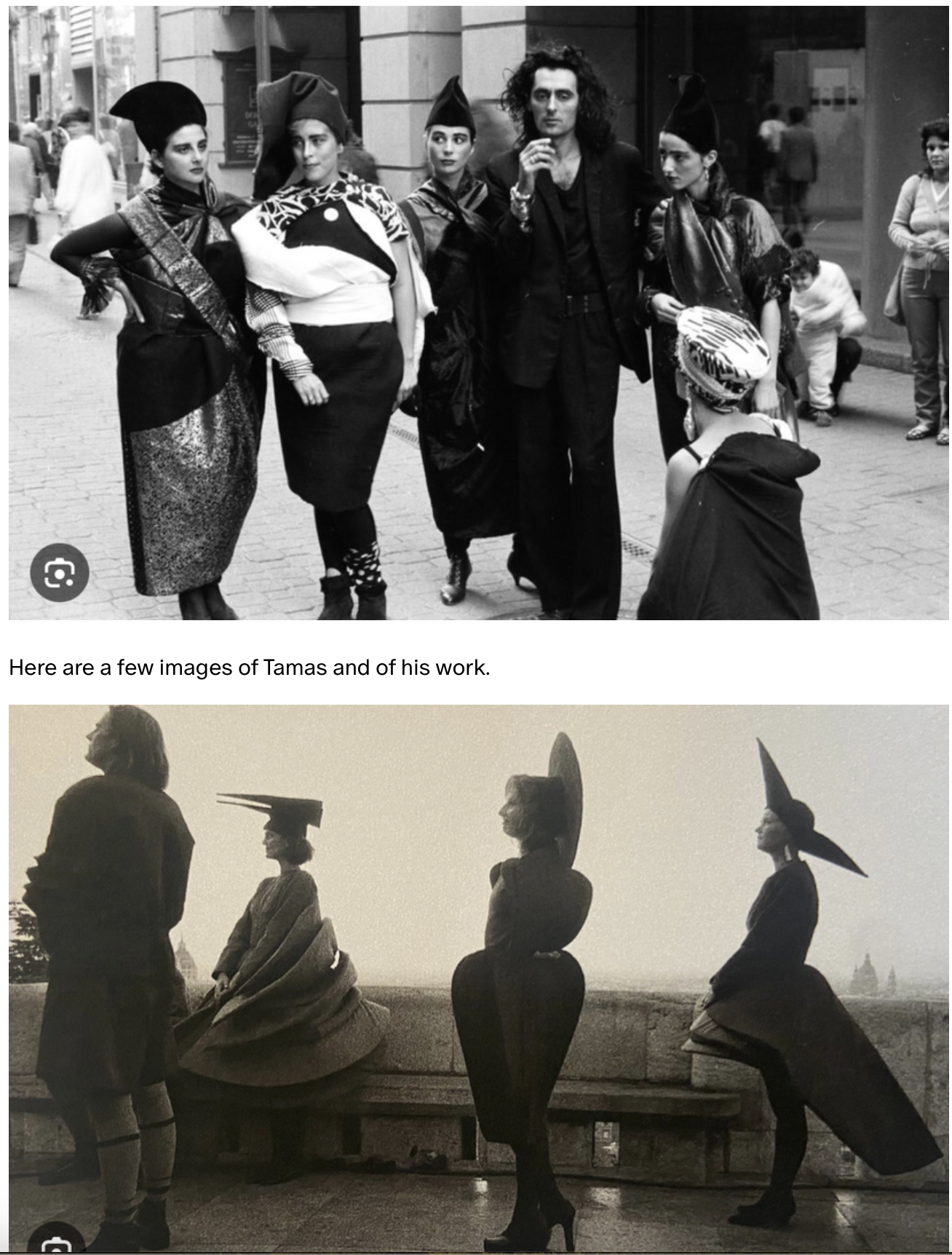
The episode is wonderful and worth a listen, though it's truly more of an exploration of Kiraly specifically than it is of the idea of what fashion and, more importantly, style could mean outside the confines of capitalism. Avery Trufelman does point out that many of us assume without capitalism, and under something like the communist regime of the 1980s, fashion and expression would disappear. That everything was grey and boring and uniform. It's good to be reminded that wasn't the case. Because it means expressive, innovative fashion could exist beyond capitalism again, ideally under much better circumstances.
Something immediately clear in Kiraly's work is that it is intended to be art, a statement of something, much more than it is a commodity. It's obviously not designed to be mass produced at scale for profit. But that doesn't necessarily mean all fashion that is free from capitalism would need to make you look like a walking sculpture.
Before I go any further, let's define capitalism. Because it gets thrown around a lot and I don't think you need to be a Marxist scholar to understand it. Capitalism is an economic and political system in which a country's trade and industry are controlled by private owners for profit. Let's take it one step further and define profit, because this is important. Profit is a financial gain, especially the difference between the amount earned and the amount spent in buying, operating, or producing something. The argument against alternatives to capitalism is often "well how does anyone get PAID?!" "what?! you don't wanna make any money?!" This is entirely bad faith or at least a grave misunderstanding. Paying workers, paying yourself, dignified compensation for labor is an operating cost for producing something. Profit is the amount left over that the owners get to pocket AFTER those costs are covered. Under capitalism, profit, that amount leftover is the most important part. That means the incentive is ALWAYS to make the cost of producing something as low as possible. Which means the cost of paying workers is not valued, the cost of taking care of the planet is not valued -- in fact, these are seen as burdens that eat away at the profit. And often, the people who pocket the profit aren't doing the labor of making the thing at all!! But I digress...
What does that mean for us? That means that the fashion industry as we know it is based first and foremost around profit. The focus is not the product, the focus is not the art, not the expression, not the planet, not the workers making the clothes, the focus is on making a PROFIT. So costs are cut everywhere possible. Workers are paid less, which means work is outsourced to countries with lax regulations on working conditions. Instead of selling us one great $300 item that last they'd rather sell us 10 terrible $40 items that fall apart or go out of style. And then they spend money advertising new trends to us that make us feel like we need to buy more more more as our last haul becomes obsolete by the second. The clothes are worse. We feel worse about our clothes. So we buy more bad clothes.
Have you ever had that experience where you're at a store and you pick up a shirt that is so close to being cute but they've added some absolutely ridiculous unnecessary design element that ruins it? Like some random ruffle or pocket or sparkle (and not in a good way, just in a WHAT way) and you're like "fuck that would've been perfect but they ruined it with this random thoughtless add-on!! That's the direct impact of capitalism on design. A relentless manufactured newness to try to make you go "well I don't have one EXACTLY like this so I guess I need the one with the pocket and the one with the ruffle and the one with the sparkle?" Novelty borne not of innovation or expression, not out of some designer's brilliant idea but out of the shareholders' thirst for profit. Novelty for the sake of novelty. This is not good design. The infinite production of clothes is not making us dress better. The perceived abundance of capitalism is not good for our sense of style. Instead it drowns us in the next thing the next thing the next thing. It separates us from ourselves so that we buy and buy and buy.
It's really bleak! But I also think it's one of the areas where meaningful change is most possible! Because the alternative to fashion under capitalism is not boring grey blobs of nothing. It's style tied to beauty and expression instead of the demands of profit. It's clothing that is allowed to be created with care and thoughtfulness, that isn't tethered to trends but instead to experimentation or function. It's clothing made by people who are earning a dignified living, even if the price is higher. Because we value their work and we value our clothes as meaningful products with lasting impacts, not as status symbols or attempts to catch up with the speeding train of trends and then discard when they become obsolete. It doesn't mean we never shop, we never ogle, we never play dress up, we never care about our clothes. It's the opposite!
There's a wonderful episode of another podcast I love, Conscious Style, that offers 7 Alternative Sustainable Fashion Business Models to our current system. It's such a refreshing perspective on this industry, on what could be if we work towards it. It's so hopeful, and it reminded me that none of the things I love about style or fashion have anything to do with capitalism. In fact, capitalism gets in the way.
You might be afraid that reckoning with the influence of capitalism in how we consume clothes would take the fun out of fashion. It doesn't, I promise. Because when we are shopping out of a capitalism-induced impulse, it doesn't end up being fun in the long run. It's like a sugar rush followed by a crash. I've seen closet after closet full of these purchases that aren't rooted in need nor in love. But when your relationship with style shifts away from capitalism and instead is based in you and what you actually need and want and love...it can actually be more fun, more affirming, more creative.
We may be a long way from dismantling capitalism and replacing it with some form of socialism that works, but in the meantime I think it's really valuable to be aware of what parts of the industry and what parts of our relationship to our clothes/style comes from a love for beauty, expression, and function vs what parts are manufactured by capitalism. That helps us make better choices while living under this system. It helps us interrogate if we're shopping to scratch an itch or because something is truly beautiful. If we're buying something because we need it or because we got an Instagram ad for it. And if we're buying something do we need to buy it new or can we find it used?
I'm very far from perfect on this. I'm still working on identifying the urge to shop because I'm bored or sad or being heavily advertised to. I'm working on moving slow, revisiting what I have, and when I do shop trying to shop with intention. Sometimes I still fall prey to a fast fashion item or impulse buy! Sometimes I regret it and sometimes I honestly don't. Nobody needs to be perfect on this, in fact no one can be perfect on it under capitalism. But I really believe if we all commit to being a little better every day, and to bringing people in to this practice with open arms, that things can change.
Thanks for reading! And as always, if you’d like to book a one-on-one styling session with me for anything from your everyday wardrobe to wedding or event styling, you can book directly with me.